Jay Walmsley — Professional Problem Solver for Small Business
30+ years in sales, marketing and community building across APAC. I help small businesses win customers, build referral pipelines, and create partnerships that actually grow revenue.
I install the Infrastructure—Networking, Education, and Technology—that turns a "Business" into a Sovereign Territory.

"Jay Walmsley is the Chief Chaos Coordinator and the Architect of Bconnected World. After decades of navigating the friction of traditional networking, Jay codified the Bconnected Blueprint—a mandate for business owners to reclaim their data, their time, and their reputation. He doesn't just run a network; he governs an ecosystem designed for 100% closing rates and zero-waste marketing."

Professional Problem Solver
A 30-year track record in sales, marketing and local community-building — practical help, not theory.
The Reputation Loop - Stop "pitching" and start positioning. We use values-based networking to build your Authority Equity.
Institutional Mentorship- Transition from Founder to Architect through our Process Driven curriculum.
B.O.S.S. Infrastructure - Data is Sovereign. We install the systems that automate your growth and protect your time.
"Most business owners are screaming into the void of the 3% who are ready to buy today.
I build the Reputation Loop so the other 97% choose you the moment they are ready. We don't chase the rain; we build the bucket."
The +5 Standard:
Operating a high-density ecosystem across the NSW and QLD corridors.
Framework Creator:
Architect of the Reputation Loop—the strategy currently governing hundreds of high-growth businesses.
Sovereign Legacy:
Transitioning businesses from "Owner-Dependent" to "Market-Dominant."
Contact & Social — Quick Links
how to reach Jay across channels.
instagram.com/bconnected.au

The Elasticity Gap: Structural Liability in 2026
Business Strategy, Operations, Agencies
The Elasticity Gap: Why Your “Perfect System” Is a Structural Liability in 2026
In 2026, the biggest operational risk for businesses and agencies isn’t chaos — it’s the polished, tightly tuned system that can’t stretch when reality changes. The gap between how rigid your operations are and how volatile your environment is has a name: The Elasticity Gap.
What Is the Elasticity Gap?
The Elasticity Gap is the mismatch between the flexibility your systems have and the flexibility your market demands. When demand spikes, regulations shift, or client expectations jump, your operations either stretch to absorb the shock — or they crack.
Every business and agency now operates in three overlapping realities:
Demand volatility — campaigns go viral overnight, budgets freeze just as quickly, and buying cycles compress or elongate with little warning.
Talent fluidity — hybrid teams, freelancers, and partners come together and dissolve around projects, not job titles.
Technology acceleration — AI, automation, and new tools constantly rewrite what “efficient” looks like.
The wider the gap between these moving parts and your ability to flex, the more revenue you leave on the table — and the more reputational risk you carry with clients and stakeholders.
Why Your “Perfect System” Is a Liability in 2026
Many businesses and agencies have spent the last decade optimising for predictability: standard operating procedures, tightly defined roles, fixed tech stacks, and carefully sequenced workflows. These “perfect systems” were designed for stability, not turbulence.
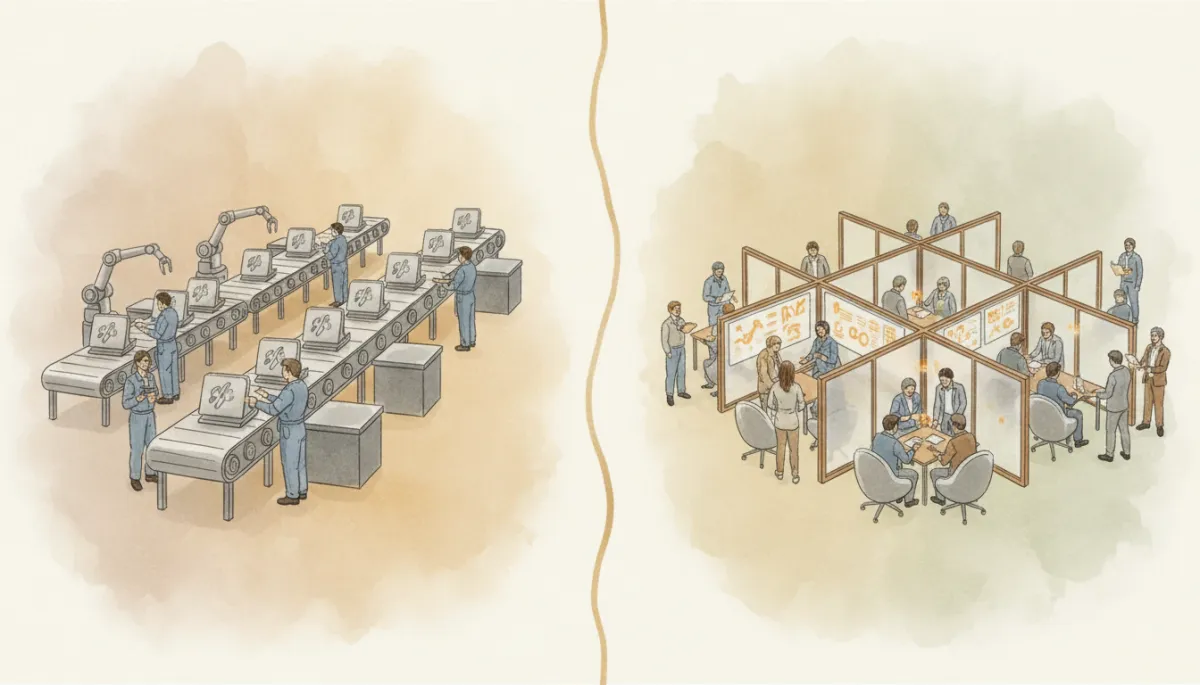
Systems built for control struggle when markets demand speed and flex.
In 2026, that rigidity becomes a structural liability in three critical ways:
Fixed capacity in a variable world. When your resourcing, approvals, and delivery model assume “average” demand, you either burn out your team in peak periods or miss revenue when opportunity knocks. Both outcomes erode trust with clients and partners.
Tool lock-in that slows innovation. A perfectly tuned tech stack can become a cage. If every process, report, and role is bound to a single platform, introducing AI, automation, or new channels becomes a multi‑month project instead of a rapid test.
Process worship over outcomes. Teams start serving the system instead of the client. Work that doesn’t fit the template — urgent launches, cross‑channel experiments, co‑created projects — gets delayed, discounted, or quietly dropped.
📌 Key Takeaway: In 2026, the question isn’t “How polished is our system?” but “How fast can it bend without breaking?”
What Elasticity Looks Like for Businesses and Agencies
Closing the Elasticity Gap doesn’t mean abandoning structure. It means designing systems that have deliberate slack and modular components that can scale up, down, or sideways without a full rebuild.
Elastic capacity: Blending core teams with vetted freelancers and partner agencies so you can respond to surges without permanent headcount risk.
Elastic workflows: Standard processes for 70–80% of work, plus fast‑track paths for high‑impact, time‑sensitive initiatives that can bypass non‑essential steps.
Elastic tech: A stack built around interoperable tools and APIs, making it simple to plug in new AI, analytics, or automation layers without rewriting everything.
Moving From “Perfect” to Resilient
For leaders in businesses and agencies, the priority in 2026 is not to defend the perfect system you built in 2019, but to redesign for resilience. Audit where you are most rigid: approvals, staffing, reporting, or technology. Then ask a simple question: “If demand doubled next month, would this break?”
The organisations that will win this decade are not the ones with the most impressive process manuals. They are the ones whose systems can stretch, compress, and reconfigure quickly — without losing quality or burning out their people. That is how you close the Elasticity Gap and turn uncertainty from a threat into a strategic advantage.