Jay Walmsley — Professional Problem Solver for Small Business
30+ years in sales, marketing and community building across APAC. I help small businesses win customers, build referral pipelines, and create partnerships that actually grow revenue.
I install the Infrastructure—Networking, Education, and Technology—that turns a "Business" into a Sovereign Territory.

"Jay Walmsley is the Chief Chaos Coordinator and the Architect of Bconnected World. After decades of navigating the friction of traditional networking, Jay codified the Bconnected Blueprint—a mandate for business owners to reclaim their data, their time, and their reputation. He doesn't just run a network; he governs an ecosystem designed for 100% closing rates and zero-waste marketing."

Professional Problem Solver
A 30-year track record in sales, marketing and local community-building — practical help, not theory.
The Reputation Loop - Stop "pitching" and start positioning. We use values-based networking to build your Authority Equity.
Institutional Mentorship- Transition from Founder to Architect through our Process Driven curriculum.
B.O.S.S. Infrastructure - Data is Sovereign. We install the systems that automate your growth and protect your time.
"Most business owners are screaming into the void of the 3% who are ready to buy today.
I build the Reputation Loop so the other 97% choose you the moment they are ready. We don't chase the rain; we build the bucket."
The +5 Standard:
Operating a high-density ecosystem across the NSW and QLD corridors.
Framework Creator:
Architect of the Reputation Loop—the strategy currently governing hundreds of high-growth businesses.
Sovereign Legacy:
Transitioning businesses from "Owner-Dependent" to "Market-Dominant."
Contact & Social — Quick Links
how to reach Jay across channels.
instagram.com/bconnected.au

The Trust Tax: AI Strategy's Hidden Cost in 2026
AI Strategy, Business Risk, Trust
The Trust Tax: Why Your “Seamless” AI Strategy Is a Structural Liability in 2026
In 2026, most businesses and agencies proudly showcase “seamless AI”: invisible assistants, automated workflows, and smart decisions happening in the background. It looks slick. But beneath the frictionless experience, many organizations are quietly paying a growing cost that doesn’t show up on any invoice: a trust tax.
What Is the Trust Tax?
The trust tax is the hidden premium you pay when customers, employees, or regulators don’t fully trust how you use AI. It shows up as:
Extra approvals and manual checks on AI outputs “just in case”
Slower sales cycles because clients demand more assurances and audits
Higher compliance, legal, and insurance costs after AI-related incidents
Research from the World Economic Forum and McKinsey has been clear: trust in AI is now a business imperative, not a “nice to have.” Organizations that can explain, govern, and justify AI decisions see higher adoption, stronger loyalty, and better ROI than those that simply deploy black-box tools and hope for the best.
Why “Seamless” AI Has Become a Structural Liability
Over the last two years, businesses have raced to integrate AI agents into every touchpoint: customer support, tax and compliance, content production, media buying, and more. Vendors promise “effortless” and “fully autonomous” experiences. The problem? What feels seamless to leadership can feel opaque and uncontrollable to everyone else.
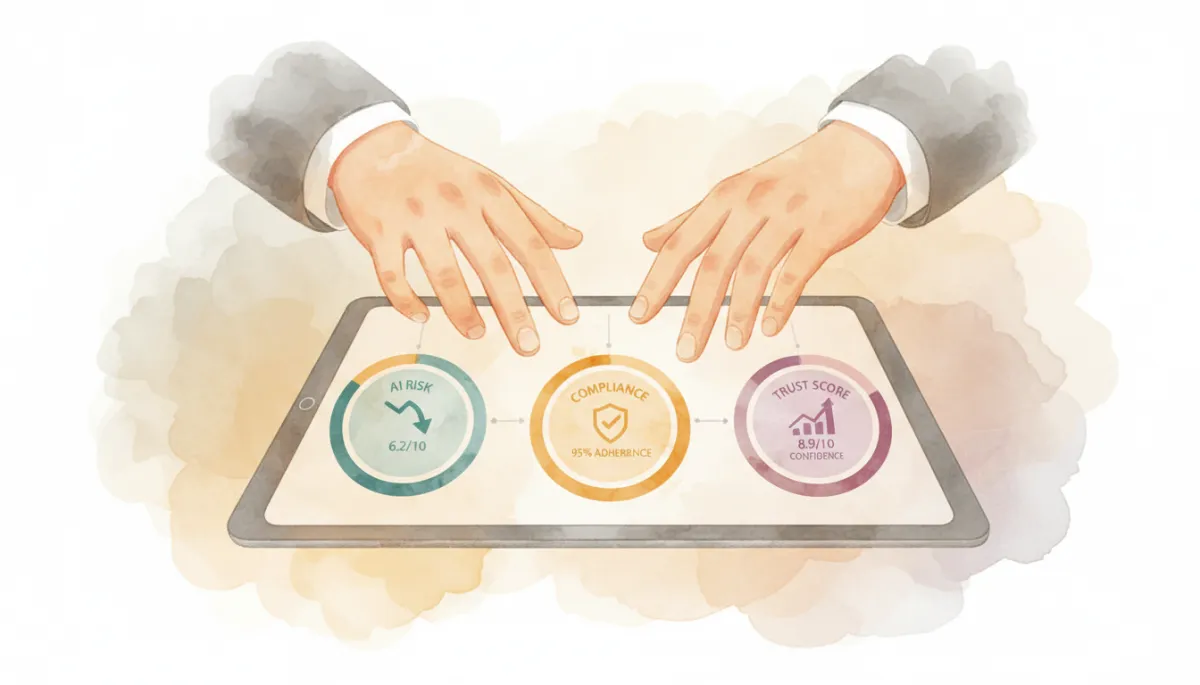
Hidden AI complexity quickly turns into visible trust and compliance costs.
In 2026, several forces turn “seamless” into a structural risk for businesses and agencies:
Regulation is catching up. Governments and tax authorities, guided by OECD and Gartner recommendations, now expect explainable AI, clear documentation, and continuous monitoring—especially around finance, tax, and public services. If you can’t show how your AI arrived at a decision, you’re exposed.
Clients demand transparency. Forbes reports that customers are increasingly willing to pay a premium for brands that are open about how they use AI. Agencies that hide automation behind glossy interfaces risk looking deceptive when something goes wrong.
Employees are skeptical. When AI quietly rewrites proposals, flags tax positions, or adjusts pricing, teams instinctively double-check the work. Instead of saving time, your “autonomous” agents create an extra review layer—another form of trust tax.
From Invisible Automation to Visible Accountability
The leading organizations in 2026 are reframing their AI strategies around trusted, accountable systems rather than seamless magic. Across sectors—from tax administration to marketing and operations—a few patterns stand out:
Explainable by design. AI agents surface their reasoning, data sources, and confidence levels. For example, AI used in tax planning logs every assumption and cites relevant regulations, making audits faster and less painful.
Clear guardrails and escalation paths. High-impact decisions—pricing changes, tax positions, hiring, credit approvals—are never fully automated. AI proposes; humans approve, with thresholds and alerts defined upfront.
Unified governance. Instead of scattered tools, mature organizations unify AI infrastructure, monitoring, and policies. This reduces hallucinations, bias, and drift—and gives leadership a single view of risk and performance.
💡 Pro Tip for Agencies: Make AI explainability part of your pitch. Showing clients how you govern and audit AI decisions is now a differentiator, not a distraction.
Turning the Trust Tax into a Competitive Advantage
For businesses and agencies, the question is no longer “How seamless is our AI?” but “How confidently can people rely on it?” To move from structural liability to strategic asset:
Map where AI already makes or influences decisions—especially around money, people, and compliance.
Quantify your trust tax: extra review hours, delayed deals, escalations, or write-offs caused by AI uncertainty.
Invest in governance, explainability, and client education with the same seriousness you applied to AI pilots in 2023–2024.
In a market where AI agents are everywhere and infrastructure spending is exploding, the real differentiator is no longer access to models. It’s the confidence your stakeholders have in how you use them. Reduce the trust tax, and your “seamless” AI strategy stops being a liability—and starts compounding into durable, defensible value.