Jay Walmsley — Professional Problem Solver for Small Business
30+ years in sales, marketing and community building across APAC. I help small businesses win customers, build referral pipelines, and create partnerships that actually grow revenue.
I install the Infrastructure—Networking, Education, and Technology—that turns a "Business" into a Sovereign Territory.

"Jay Walmsley is the Chief Chaos Coordinator and the Architect of Bconnected World. After decades of navigating the friction of traditional networking, Jay codified the Bconnected Blueprint—a mandate for business owners to reclaim their data, their time, and their reputation. He doesn't just run a network; he governs an ecosystem designed for 100% closing rates and zero-waste marketing."

Professional Problem Solver
A 30-year track record in sales, marketing and local community-building — practical help, not theory.
The Reputation Loop - Stop "pitching" and start positioning. We use values-based networking to build your Authority Equity.
Institutional Mentorship- Transition from Founder to Architect through our Process Driven curriculum.
B.O.S.S. Infrastructure - Data is Sovereign. We install the systems that automate your growth and protect your time.
"Most business owners are screaming into the void of the 3% who are ready to buy today.
I build the Reputation Loop so the other 97% choose you the moment they are ready. We don't chase the rain; we build the bucket."
The +5 Standard:
Operating a high-density ecosystem across the NSW and QLD corridors.
Framework Creator:
Architect of the Reputation Loop—the strategy currently governing hundreds of high-growth businesses.
Sovereign Legacy:
Transitioning businesses from "Owner-Dependent" to "Market-Dominant."
Contact & Social — Quick Links
how to reach Jay across channels.
instagram.com/bconnected.au

When Business Systems and Automations Fail
Business Operations, Automation, Risk Management
Sheer Panic: When Systems and Automations Fail in Your Business
The moment a critical system goes down or an automation misfires, time slows and adrenaline spikes. For businesses and agencies that rely on technology to deliver consistent results, that instant of sheer panic is more than a feeling—it is a direct threat to revenue, reputation, and relationships.
The Anatomy of Sheer Panic in Modern Operations
Sheer panic rarely comes from one small bug. It erupts when systems and automations fail at the exact moment you expect them to quietly work in the background. A payment gateway stops processing during a big launch. An email automation sends the wrong offer to thousands of subscribers. A project management tool locks your team out on a client deadline. Suddenly, leaders, managers, and specialists are all asking the same question: “How did this happen?”
For businesses and agencies, automation is supposed to reduce stress, not create it. You invest in tools to eliminate manual work, enforce consistency, and scale operations. Yet the more you lean on these systems, the more vulnerable you become when they break. That moment of panic is really the collision between high dependency and low preparedness.
When Systems and Automations Fail: Real-World Scenarios
System and automation failures show up differently across organizations, but the impact is always tangible. Consider a few common patterns that trigger chaos:
Sales and revenue disruption: E‑commerce checkouts fail, subscription renewals do not process, or invoices are not sent on time, leaving money on the table and confusing customers.
Customer experience breakdowns: Support tickets vanish, onboarding sequences stop mid-way, or notifications never fire, making clients feel ignored or abandoned at critical moments.
Data and reporting gaps: Integrations between CRM, marketing, and finance tools break, leading to inaccurate dashboards and decisions made on incomplete information.
Compliance and reputation risks: Opt‑out preferences are ignored, deadlines are missed, or sensitive information is sent to the wrong recipient, exposing the business to legal and brand damage.
💡 Pro Tip: Any process that feels “too important to ever fail” is precisely the one that needs a documented backup plan and regular testing.
Why Businesses Feel It First—and Hardest
For established businesses, system failures ripple far beyond a single workflow. They affect entire departments and revenue streams. Operations teams scramble to patch processes manually. Finance teams worry about cash flow and forecasting. Leadership has to explain delays or errors to stakeholders, sometimes in public. The emotional cost inside the organization can be just as damaging as the financial cost.
Many businesses also operate on a complex stack of legacy systems layered with newer cloud tools. When one piece fails, it is rarely isolated. A simple integration glitch can cascade into a multi‑system outage. The result is a sense that “everything is broken”, even if the root cause is relatively small. Without clear ownership and monitoring, the search for that cause becomes a frantic, all‑hands‑on‑deck exercise.
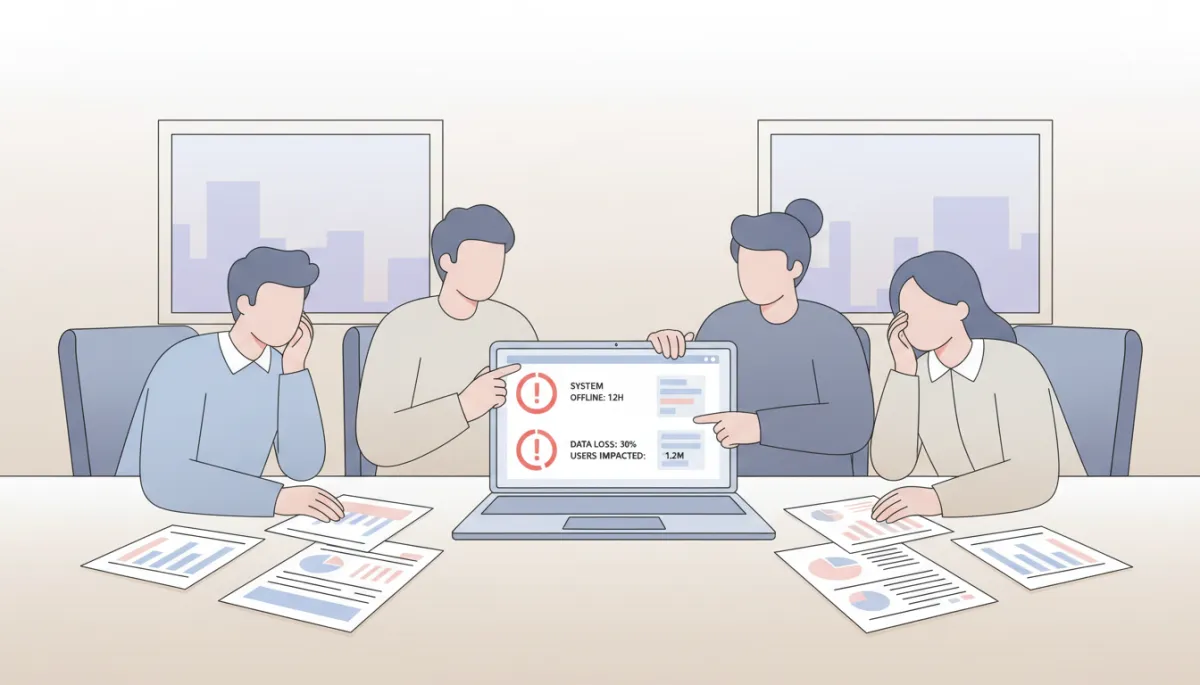
Post‑incident reviews turn panic into process improvements and stronger resilience.
The Agency Perspective: Double Exposure to Risk
Agencies live in a uniquely vulnerable space. When systems and automations fail, they are not just dealing with their own internal disruption—they are also responsible for the impact on multiple clients at once. A broken reporting automation can affect ten client accounts. A misconfigured ad platform integration can drain several budgets in a single afternoon.
This creates a particular kind of sheer panic: the fear of eroded trust. Clients expect agencies to be the experts, the ones who “have it handled.” When a campaign does not launch, a funnel stops tracking, or scheduled content never publishes, agencies must manage the technical fix and the client relationship at the same time. How they respond in those first few hours often determines whether the incident is remembered as a forgivable glitch or a reason to churn.
From Panic to Prepared: Building Operational Resilience
You cannot eliminate every failure, but you can dramatically reduce panic by designing for resilience. For both businesses and agencies, that means moving from blind trust in tools to intentional governance of systems and automations. A few practical shifts make a major difference:
Map your critical journeys. Identify the automations and systems that directly touch revenue, compliance, or client deliverables. These deserve higher levels of monitoring, documentation, and backup.
Introduce simple safeguards. Use alerts, approval steps, and test environments before changes go live. A 10‑minute preflight check can prevent a 10‑hour emergency.
Document “break glass” procedures. When something fails, who does what in the first 30 minutes? Clear roles and checklists turn chaos into coordinated action.
Run post‑mortems without blame. After each incident, capture what happened, why it happened, and how you will prevent a repeat. Over time, this builds a culture of learning instead of fear.
📌 Key Takeaway: Resilient organizations do not rely on perfect tools; they rely on clear processes, honest communication, and continuous improvement.
Turning Sheer Panic into Strategic Advantage
Every failure reveals a weak link in your operational chain. For businesses and agencies willing to look closely, those painful moments become powerful feedback. They show you where visibility is missing, where ownership is unclear, and where you have been trusting automation more than you should.
The goal is not to eliminate technology-driven efficiency—that would be impossible and unwise. Instead, it is to balance automation with awareness, contingency, and communication. When your next system inevitably hiccups, you want your team to feel pressure, not panic; urgency, not chaos. That shift is what separates organizations that merely survive incidents from those that use them to build deeper trust, stronger teams, and more resilient operations.